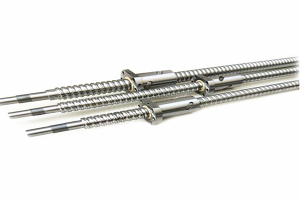
Lead screws are not a legacy technology relegated to low-end machines. In modern equipment design, they remain a deliberate choice where their specific characteristics—self-locking, quiet operation, corrosion resistance, and low cost—outperform more expensive alternatives. Understanding where lead screws fit is the difference between over-engineering an axis and specifying it correctly.
The defining characteristic: sliding friction. Unlike ball screws, which use recirculating balls to achieve over 90% efficiency, lead screws rely on direct sliding contact between the screw thread and the nut. This is often framed as a drawback, but in modern equipment it is frequently the point. Sliding friction makes many lead screw configurations self-locking: an axial load applied to the nut will not back-drive the screw. In vertical lift axes, this eliminates the need for a motor brake or continuous holding current. The load stays where it is put, and the system consumes no power to hold position.
3D printers and small-format CNC. Lead screws are standard on the Z-axis of 3D printers, where the platform must hold position without drawing power and where lead accuracy matters more than speed. In CNC routers and engraving machines, they handle tool height adjustment and short-travel worktable motion. The rigidity of a lead screw, compared to a belt drive, is an advantage on vertical axes that must resist movement when stopped. For these applications, the trade-off is clear: lower efficiency is acceptable because the axis moves intermittently and slowly, while self-locking and cost matter more.
Laboratory and medical instruments. Many modern lead screw nuts are self-lubricating polymer designs, eliminating grease migration and particulate contamination. This makes them suitable for cleanroom environments, laboratory pumps, and medical devices where a ball screw’s lubrication requirement would be a liability. Stainless steel screws paired with polymer nuts also provide corrosion resistance in humid or washdown-adjacent settings. In syringe pumps and analytical instruments, the smooth, low-vibration motion of a lead screw is often preferred over the more complex ball recirculation of a rolling-element drive.
Noise-sensitive equipment. Ball screws generate mechanical noise from ball recirculation. Lead screws run quietly, especially with precision roll-formed screws and injection-molded nuts. This is why lead screw technology became standard in office printers and remains relevant in equipment where acoustic performance is part of the specification—medical analyzers, laboratory automation, and office-adjacent machinery.
Adjustment and positioning axes. Many modern machines include axes that are set and then left alone: sensor positions, guide rail adjustments, tensioning stations, and fixture alignment. These axes need fine, repeatable adjustment, not high-speed travel. A lead screw provides the mechanical advantage and holding stability required, at a fraction of the cost of a ball screw. In this role, the lead screw is not a compromise—it is the correct specification.
The honest limitation. Lead screws are not a substitute for ball screws in high-duty, high-load axes. Plastic and stainless steel lead screw assemblies are typically limited to roughly 50% duty cycle under rated load, and bronze nuts with higher load capacity generate more frictional heat, often dropping duty cycle to 10% or lower. High load combined with high RPM relative to the thread size will overheat and fail. Modern equipment uses lead screws where their traits align with the application—not as a universal replacement for rolling-element drives.
Selection principle. The question is not whether lead screws are “modern enough.” It is whether the axis needs self-locking, quiet operation, corrosion resistance, or a low-cost short-stroke solution. If it does, a lead screw is the correct specification. If it needs continuous high-speed motion under load, a ball screw is. Modern equipment design uses both, deliberately.
Areswin Precision Machinery Co.,Limited has produced custom lead screws for a large variety of applications and equipment over the years, the rise of the BioTech industry worldwide has created the greatest challenges and opportunities for our company.
Please contact us for more information:CONTACT – ARESWIN